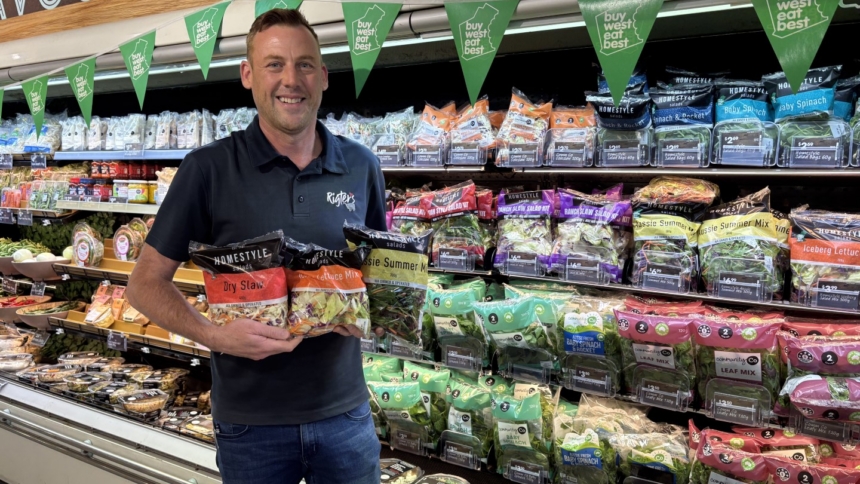
“If they can tell the story behind it, of what it is and why it’s special, that helps get it on the shelf,” Stuart says.
The operations manager for Rigters Supermarkets, the family-owned group behind three IGA stores in Geraldton, says simply putting another oil on a shelf against cheaper oils, for example, isn’t going to work.
“But if you can say, yes, it’s a few dollars more but did you know it’s made by hand by the owner in small batches in Western Australia? That could justify the extra,” he says.
He uses Block 275, the cold-pressed canola oil made by Fiona and Liam Mann on their family farm near Geraldton, as a winning example.
“It’s not canola oil versus canola oil – it’s premium for a reason; it’s not pumped out of a factory overseas, it has care and love in it,” Stuart says.
Helping customers choose local
Having strong local stories helps lift a product on several levels. It gives staff something real to say when a shopper pauses in the aisle to ask questions and informs shoppers about why the product might be worth a bit more.
“Customers want to know why (a product) is better than the one next to it,” Stuart says. “Take lamb, ‘you can get this one, which might be cheaper, but did you know this one is local, it’s grass-fed and better for you’. A lot of people like these stories. And it could be the difference between them buying it or not.”
When customers respond well to local products, this is where independent supermarkets like Rigters, which has been serving the Geraldton community for more than 50 years, can adapt to meet the market.
“We can tailor our range to locals and we can use local suppliers who might struggle to produce volume elsewhere,” Stuart says. “There might be a boutique product that will work well in Geraldton, for example, but it isn’t going to work well elsewhere. We can just take it for one store if the local market demands it.”
Getting local suppliers into stores for taste tests also wins hearts (and stomachs). ‘This puts producers right in front of the customers to share their stories,” Stuart says, adding that chefs cooking in-store with local produce such as Block 275 also has an impact. “They might taste the oil but not buy any because they don’t need it that day, but the next time they are going down the oil aisle they remember and buy it.”
These kinds of in-store pop-ups give staff more information about local suppliers to share with customers and on socials, too.
Getting to know suppliers
Stuart says it’s this kind of relationship building that helps make Meet the Buyer™ such a valuable event. The annual Buy West Eat Best trade show puts producers in front of potential buyers, including supermarkets, restaurants and foodservice operators.
He remembers walking the floor at last year’s event and finding popcorn producer Rademi. The Vaswani family, who pivoted from imported foods to making snack foods locally, had already found favour in school canteens for the Amaise olive-oil-based popcorn.
“They had some really interesting flavours,” Stuart says. “There’s a lot of novel products out there but when you hear the story behind the product, it really helps.”
This face-to-face interaction is also far more powerful than a cold email. “I got one last week from a producer down south but there was no story attached,” Stuart says. “When you’re at Meet the Buyer™ the people behind the product are there and you not only get to taste what they do but get to know their story.”
Beating the odds
Aside from a good story, there are some very practical things producers can do to help get on supermarket shelves. They need packaging with compliant nutritional information, a barcode, and a margin that works for both supplier and buyer.
“A lot of producers do not realise the margin expectations you need in a supermarket,” he says. “We have had people say ‘buy it from us for $10 and sell it for $11’ but that’s not going to cut it when you’re paying all the overheads, including wages.”
Producers can also open more doors with a gesture of confidence. “If you want to show faith in your product, say ‘I’ll put this amount in and if it doesn’t sell I’ll buy it back’,” Stuart says. “It’s saying to us, ‘if you give me a shot, I won’t let you down’.”
These small acts of goodwill build the kind of reputation that travels well beyond Geraldton, to other IGA stores.
“When the supplier wants to go into a store in Perth and use us as a reference, I can say ‘these guys are great, we’ve had it for six months and it’s really taken off’,” Stuart says. “It’s a referenceable resume in a way.”
Making the most of the trade show
Stuart’s advice for producers heading to Meet the Buyer™ this October is simple: Think about what makes your product so good and talk to that. “Go in with your full story. Don’t just say it’s an oil, say why it’s better and how. You have this great chance at Meet the Buyer to tell your story face to face, so don’t waste it.”
He urges buyers to get along to the event if they can, even it means coming down (or up) to Perth. “It’s really worth it, but you need a plan as there is so much to see,” Stuart says. “Get the Buyers Guide, pick your top 10 and make a beeline for them first.”
Just don’t forget to leave room for surprises as you wander the floor because you never know what stories you’ll hear. As Stuart can attest over years of watching new products win places on supermarket shelves, the ones with good stories, as well as great flavours, really stick.
Meet the Buyer™ is at Crown Perth on Tuesday 20 October. The exhibition floor has sold out, but buyers can still book tickets to the trade show.
Note: Meet the Buyer™ is a trade and industry event only but you can support local by supporting the businesses mentioned and looking out for local produce wherever you shop.