Does the health of a queen bee affect the quality of the honey her colony produces? Can a stronger, more hygienic hive yield honey with naturally lower bacterial counts? And, perhaps most intriguingly, does the type of music playing near a hive make the bees happier?
The answers Dr Peter Detchon, former University of Western Australia medical professor, has been pursuing here have helped shape the quality and direction of Australian Natural Biotechnology (ANB), the business he co-founded with Ben Pan in 2010.
Where science meets nature
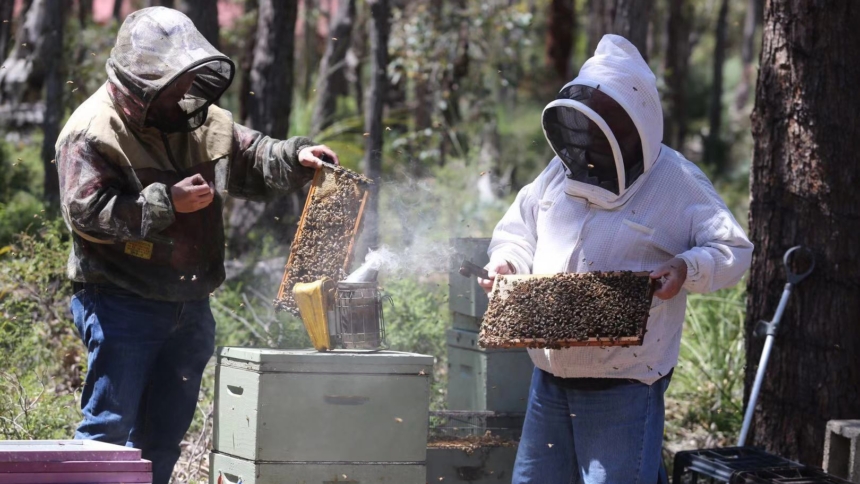
Peter’s family had been keeping bees for three generations. He started researching what was happening in the hive, specifically the queen bee and the effect her health had on the colony and the honey those busy worker bees produced.
“He wanted to see if it was possible to have honey with fewer bacteria by creating healthier bees and a stronger hive community,” explains ANB finance manager Joyce Qin.
The reason this matters is practical, too. While honey contains natural bacteria, different countries have different limits on acceptable levels. China, one of the most stringent markets, has such tight thresholds some Western Australian honey wasn’t making the cut. Peter’s research helped produce healthier colonies to address the research. And the work continues well into his 80s, with Peter now exploring whether different types of music affect the mood and productivity of bee colonies. (Dare we say, stay tuned.)
He found a kindred spirit in Ben, who came to Australia from China in the 1990s. Though he spent years in the luxury boat building business, Ben also grew up in a beekeeping family. His and Peter’s mutual love for the so-called nectar of the gods made them determined to build the best honey business possible.
Joyce says the name of their flagship brand, Karibee, echoes the karri tree, one of the great flowering timbers the bees love, and the word caring. This embodies ANB’s philosophy of caring for the welfare of the bees who make the honey and the people who eat it.
Hive of activity
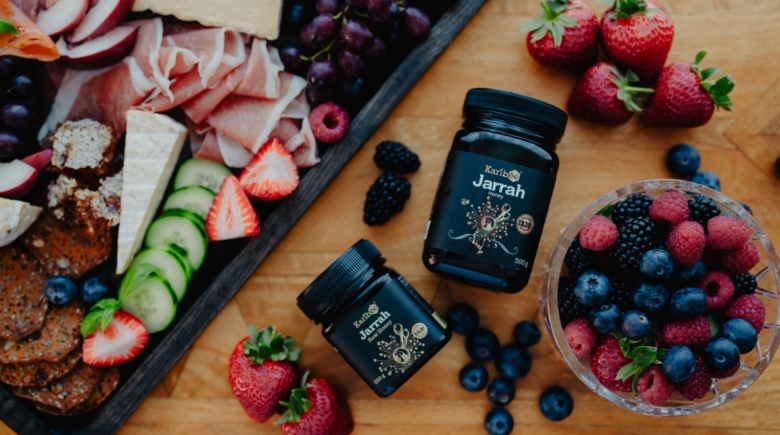
ANB is both a producer and a manufacturer. Their hives are dotted across sites in Dwellingup in the South West, where their prized jarrah honey originates, and near Bindoon and Muchea in the Wheatbelt, drawing on the flowering cycles of native eucalyptus and multi-flowering species. The resulting honey ranges from premium jarrah with its low GI rating and well-documented antibacterial activity, through to eucalyptus and multi-flower varieties that are strong entry points without compromising quality.
But the business extends well beyond its own labels, manufacturing for clients in Japan, Malaysia, Korea and beyond – packing 100 percent Australian honey into customer supplied designs and branding. It is a model, Joyce says, that suits international buyers who want to build their own brand equity while enjoying the benefits of ANB’s rigorous production standards and quality assurance.
They also have a piece of packaging technology that has attracted plenty of attention at Meet the Buyer™, the Buy West Eat Best annual trade show that brings producers and buyers together. The Easy Snap single-hand opening format was designed for packaging honey portions, but it has drawn interest from other producers, including olive oil.
“A lot of domestic manufacturers showed interest in using our machine to pack their produce, so we can find customers through the connections we make with other exhibitors,” Joyce says.
Making connections
In the early years, ANB concentrated on overseas markets but the company has increasingly seen the value of marketing in their own backyard.
“We realised we were capable of building our presence at home and that is where Meet the Buyer™ has become really important,” Joyce says.
ANB has attended the annual event since it began seven years ago. “We were booth number one – as people walked in the door we were the first ones they saw,” Joyce recalls.
And the event opened doors, too, with connections made with buyers from major Australian retailers, as well as representatives from a Chinese grocery group. The team knows it takes time to build those relationships; it’s why they keep coming back to Meet the Buyer™ to share their knowledge and give prospective buyers a taste of their honey.
“It is very hard to close a deal in one day or from any one event,” Joyce says. “For honey, there is also a lot of education involved. What is jarrah? Why is different from manuka? What does total activity mean? Buyers need time to understand and you need patience.”
The team has been delighted to see that understanding develop over the years, starting with more affordable multi-flower and eucalyptus varieties, then moving towards jarrah as customers’ palates develop and their appreciation of the medicinal benefits of honey grows.
“All the honey we make is fabulous,” Joyce says. “But there is a journey people go on and we are always happy to walk beside them.”
Meet the Buyer™ is at Crown Perth on Tuesday 20 October. The exhibition floor has sold out, but buyers can still book tickets to the trade show.
Note: Meet the Buyer™ is a trade and industry event only but you can support local by supporting the businesses mentioned and looking out for local produce wherever you shop.