Evdokia Klepec has well and truly caught the passion. “I love talking to people about truffles and how to use them – it is the best part,” she says.
Kia, as she is known, and husband John are the founders of Below & Above, in the stunning Southern Forests. The ‘Below’ refers, of course, to the truffles, while the ‘Above’ is all about wine – small-batch pinot noir, chardonnay and merlot. The name also perfectly captures the philosophy that what is nurtured below the ground, in those cool, ancient soils, is just as important as what flourishes above it.
The lure of the Southern Forests
The couple were drawn to the region through John’s commercial background in agricultural acquisitions. He knew the Southern Forests well, understood the exceptional quality of the soils, and recognised an opportunity when it presented itself. The couple bought their first property, a vineyard near Pemberton, in 2012.
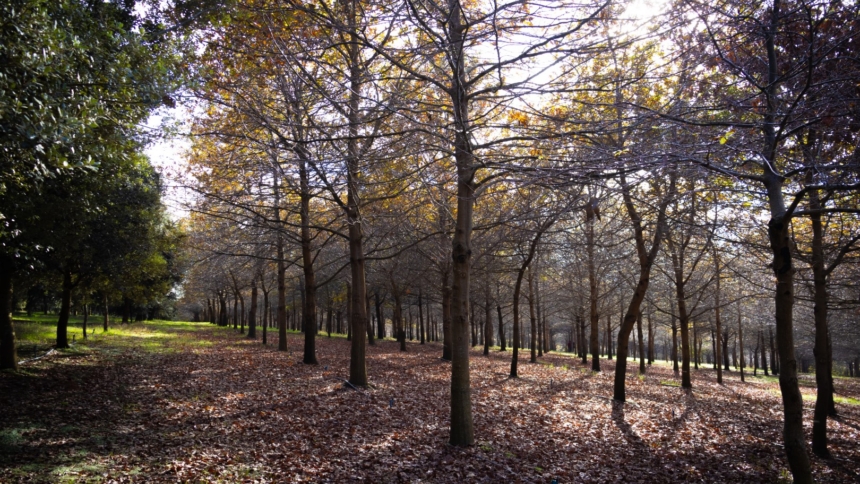
Two years later, a second property came up closer to Manjimup, in Smithbrook. The couple planted the all-important oak and hazelnut trees necessary to grow truffles 10 years ago, and found their first truffle in the fifth year.
Kia had originally wanted to plant avocados on the site, but John favoured truffles. “I didn’t win the argument,” she says with a laugh. “But then I tried truffles in Europe and I was completely blown away. And now I love them, naturally.”
The vineyard, for its part, has flourished in the hands of acclaimed winemaker Bruce Dukes, whose approach aligns perfectly with the Below & Above ethos: Make wine in the vineyard, not the winery. “You work with the vineyard, rather than against it,” Kia says.
That also means using regenerative viticultural practices and organic fertilisers to preserve the region’s rich soils into the future.
Nurturing black gold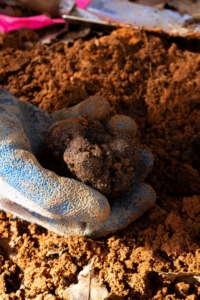
The truffle operation comes to the fore in winter for the fungi’s all-too-brief season. With its characteristic cool microclimate and deep soils, the Smithbrook farm has been nurturing the famous black gold for a decade now.
And patience is definitely a virtue when it comes to truffle growing. Full commercial production takes 12 to 13 years from the day you plant the first tree and, even then, not every truffle that comes out of the ground makes the grade.
At Below & Above, they reject about one third of their harvest – if the aroma, texture or appearance doesn’t meet their standards, it doesn’t leave Smithbrook.
“People are sometimes surprised by that,” Kia says. “But the 10 year wait has been worth it. We are producing the best truffles we have ever grown.”
A decade ago, our truffle season – which runs roughly from June through August – put Western Australian producers in a strong position, supplying a truffle-loving northern hemisphere during their off-season. Today, Chile has emerged as a major competitor, offering the same timing for supply but with dramatically lower labour costs.
What Below & Above does to counter the competition is lean into their strengths: provenance, traceability and a standard of food safety that is world class. The business is the only truffle producer in Australia to hold the ISO food safety accreditation, which is a step above the HACCP certification required for export and a mark of full, independent traceability.
“Every truffle can be traced back to the exact block number on our property,” Kia says. “We have our own refrigerated van, full control of the cold chain and we get independently audited. It means our customers can have complete confidence in what they’re buying. We are not selling a managed truffle, we are selling a Below & Above truffle.”
The art of the hunt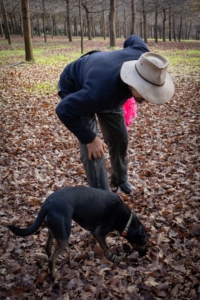
Six trained dogs work the Smithbrook farm each season, moving through the blocks in rotation, two or three kilometres at a stretch, then a rest, and it’s onto the next pair.
On a good day, the team might bring in about 60kg of truffles. Like in all farming, however, the weather can have a big effect on the type of day.
“The first Sunday of the season we cancelled because the conditions were too dangerous to send anyone out,” Kia says. “And if the wind is blowing too much, or if it’s too wet, the dogs won’t pick up the aroma of the truffle.”
It is the relationship between dog, handler and the earth that gives truffle hunting its particular romance, and its unpredictability. Kia jokes about AI as an alternative. “That’s not going to happen, and the romance of the dog is very important,” she says.
Once the truffles are unearthed and ever so carefully packed to bring up to Perth, grading begins. Each one is assessed for aroma, shape, firmness and internal condition – a small nick of a knife to check for insect damage or over-ripening.
The perfect round truffle, the Cinderella of the harvest, only makes up about 10 percent of the crop. As Kia points out, however, an irregular truffle going into a sauce is going to taste just as good as a flawless globe, and will be considerably cheaper.
“It’s about working out how the customer is going to use the truffle, but an imperfect one is just as delicious,” she says.
Extending the season
With just 10 weeks in a truffle season and the unpredictable nature of that season, those fresh beauties are gone in a flash, so it pays to get requests in early (you can order online).
Below & Above have extended the time you can get a taste of truffles with their Truffle Pétale, a freeze-dried truffle that increases the shelf life without additives or preservatives. It’s 100 percent truffle, cryo-dried to concentrate the aroma and flavour, and reconstituted with a little heat.
It is a way to keep a little black gold in the pantry long after the season has ended and a gentle nudge towards encouraging Western Australians to cook with truffles at home.
“I want the people of WA to be so proud of what we produce here,” Kia says. “We should be the truffle capital of the southern hemisphere and people should be flying in just to eat them here.”