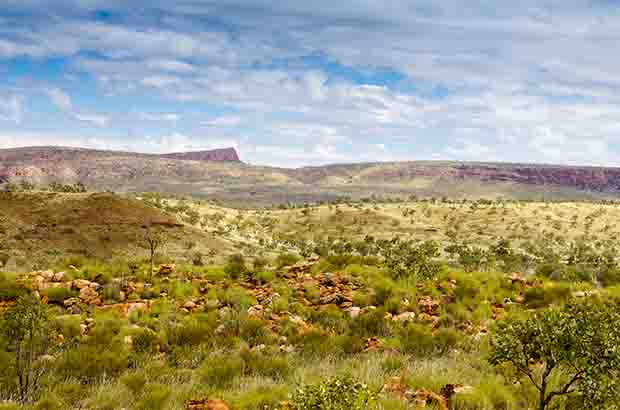
Stretching from the iconic pearl coast of Broome more than 1000km inland to the Northern Territory border, the Kimberley encompasses the World Heritage-listed Bungle Bungles, the fertile Ord River irrigation area around Kununurra, and a natural landscape that shifts from savannah grasslands to rugged gorges and glittering seas. Neighbouring Pilbara is equally dramatic; from untouched beaches to stunning national parks, ancient rock art to wide-open stations where you can camp under an unbelievable canopy of stars.
While these stunning regions are better known for mining than market gardens, they have plenty to offer in the food stakes, too. With tropical fruit and vegetables, rangeland beef and pearl meat, as well as beautiful bush foods, there is so much to savour – and some remarkable producers working hard to share it all with us.
Here are just five of the reasons we love the food that comes from our spectacular North West.
Taste the North West: Quick Guide
Beautiful beef
Welcome to a land where cattle roam thousands of hectares shaped over billions of years. Outback Beef is a fifth-generation family operation built on Yarrie Station, north of Marble Bar, one of the most remote properties in Western Australia.
Established in 1886, Yarrie Station is now under the stewardship of Annabelle Coppin, who upholds the family’s belief that caring for the animals and the land will not only produce quality beef, but protect the rangelands for future generations. With the De Grey River running through the property and rolling hills dotted with secret waterholes and gorges, it’s as pretty as it is productive. The mixture of native grasses, shrubs, legumes and rich soil imparts a natural mineral flavour to the beef that can’t be replicated.
If you’d like an immersive experience, Matters of Taste run Food Discovery Tours that give rare behind-the-scenes access to where our food is grown, including cattle stations in the Pilbara. Owners Tracey and Anthony Cotterell have been championing local food and producers for decades, connecting Western Australians with producers, learning more about what ends up on our plates and, of course, tasting it at the source.
Sweet taste of the Ord
The Ord River irrigation area in the East Kimberley is one of the great agricultural success stories of the north. Blessed with deep red soils, reliable water supply from Lake Argyle and a tropical climate, the region produces an impressive array of fresh fruit and vegetables.
Farmers along this fertile stretch grow beautiful melons, including honeydew, rockmelon and watermelon, as well as capsicum, pumpkin and lettuce.
If you’re partial to mangoes (and why wouldn’t you be), chances you’ve also had more than a few from the Ord. The conditions are ideal for varieties such as R2E2 and Kensington Pride and are among the first mangoes we see on shelves in the city, arriving late October and generally peaking in time for Christmas.
Fabulous fruit and vegetables
The Kimberley’s warm climate and long growing season create ideal conditions for produce that Western Australians further south take for granted simply because it is readily available. Aside from the aforementioned melons and mangoes, other tropical fruit such as papaya and grapefruit thrive in the region, while the northern climes also ensure green beans and sweet corn are available year round.
West Australian Corn Growers, formerly known as Trandos Farms, began with a small plot in Perth almost 90 years ago and is now the State’s largest grower of sweet corn and beans. The secret to supplying the market all year is simple but ingenious: grow in Broome for five months, then shift to Gingin in the Wheatbelt for the rest of the year.
The warmth of the Kimberley coast does the heavy lifting through the cooler months, ensuring we can eat fabulous fresh corn and beans long after the last paddock has been harvested further south.
Bush food and cool water
One of the oldest living landscapes on earth, the Kimberley is replete with bush food – native fruit, herbs, seeds and leaves – that Aboriginal communities have tended for tens of thousands of years. As they increasingly find favour in commercial and home kitchens, Western Australians are waking up to the diversity of native ingredients.
This is reflected in the growth of Tucker Bush. Founded in 2015 by horticulturalist Mark Tucek with just three bush species, the native plant specialist now offers more than 60 varieties grown across our spectacular State. These include native plants from the Kimberley, where biodiversity has bestowed an array of edible native species.
Tucker Bush’s range of dried native herbs, including pepperberry leaves, cinnamon myrtle and wattleseed, as well as some fresh varieties, can be bought online and through select retailers. You can also buy some of the plants to grow at home if you have a green thumb.
The connection to Country runs deep up north. In areas of the Great Sandy Desert that stretch into the Pilbara, springs are known as jila and considered sacred, linked by Dreaming tracks to the Martui, Yulparija, Juwaliny, Mangaa, Wangkajunga and Walmarri peoples.
Jila Water takes its name and spirit from this tradition. Proudly 100 percent Indigenous owned, it produces purified bottled water, delivered to mine sites and retailers alike. Each bottle carries an Acknowledgement of Country, a reminder that the North West offers nourishment in more ways than one.
Superb seafood
The pristine waters off Australia’s North West are as giving as the land, supporting some of the most sustainable and sought-after seafood in the country. Perth-based wholesaler Endeavour Foods sources some of its impressive range through the Kimberley’s Brown Dog Fishing Co, which uses trapping to minimise by-catch and ensure fish stocks remain healthy. Their Cone Bay barramundi comes from Tassal, which manages Australia’s only commercial ocean barramundi farm along the Kimberley coast. Prized by chefs for its clean flavour, barramundi is also subject to strict environmental management.
The Aquaculture Council of Western Australia (ACWA) champions the growth of sustainable aquaculture across the State, with members from Esperance to the Kimberley supplying everything from abalone to oysters. Established in 1981, ACWA works closely with government to foster responsible industry development. The Kimberley’s aquaculture development zones make it one of the most promising frontiers for sustainable seafood production in Western Australia.
The Kimberley and Pilbara will never be the State’s most densely farmed areas – the distances are too vast, the country too remote and wild. But that is precisely what makes their produce so special. When something is grown or raised in the North West, it carries the landscape, the rich soils, the tropical warmth, the ancient rivers and open rangelands, not to mention the deep knowledge of people who have belonged to this unique corner of the country from the start.
We love all Western Australia’s remarkable regions. Want to explore some more? Read Five reasons we love the South West’s produce, Five reasons we love Great Southern food, Five reasons we love the Wheatbelt’s produce, and Five reasons we love Southern Forests food.